|
 Products for the Battery Industry:
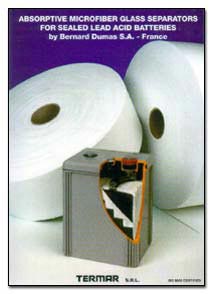
- Absorptive glass microfibre (AGM)
separators for sealed lead acid batteries
BERNARD DUMAS (Creysse - France), leading manufacturer
of absorptive glass microfibre separators in Europe,
offers a range of AGM SEPARATORS to satisfy the most stringent requirements
of VRLA battery manufacturers.
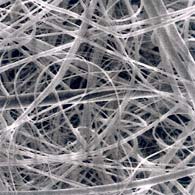
Special high quality glass microfibres are
used in the production of B. DUMAS absorptive separators,
designed specifically for sealed recombinant batteries, maintenance-free, electric vehicles, automotive starting
batteries, motorcycle and for stationary application.
B. DUMAS Recomat® separators have the following
characteristics:
- high chemical purity
- less than 3% acid weight loss
- high porosity and excellent electrolyte
absorption (900 to 1100%)
- high dimensional stability providing consistent
mechanical properties
- extremely low ohmic resistance
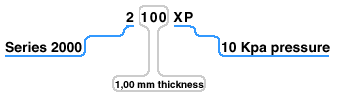
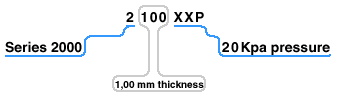
- available in thickness from 0,7 to 3,5 mm
(at 10 kPa pressure).
- Recomat® products range
1) Recomat® AGM Separators
Series 2000, basic separator, 100% glass mat, designed for all types of SLA recombinant batteries, maintenance-free, stationary application in emergency lighting system, telephone exchange, ships, electric appliance, etc.
Series 6000, special separator consisting of glass microfibres and organic synthetic microfibres, sealable by high-frequency, ultra-sound or simple pressure without temperature, to produce envelopes in standard staking machines for SLA automotive starting batteries.
Series 15000, is a microfibre glass separator with synthetic fibre suitable for all kind of VRLA batteries, such as UPS, Industrial and Traction batteries.
Series 7000, is a 100% microfibres glass separator with improved properties to be used in the most demanding applications, such as VRLA batteries for electric vehicles, submarine and start-and-stop automotive batteries.
2) Recomat® Pasting glass paper
Series 10000 is a 100% microfibres glass paper, acid resistant, to be used as pasting paper for the grid of all kind of AGM batteries.
The Series 10000 provides a typical specific surface area of 2 m2/g.
Series 9000 is a pasting paper made of a unique blend of microfibres glass and synthetic fibers to be used on pasted plates of all kind of AGM batteries.
The Series 9000 provides a typical specific surface area of 1.5 m2/g.
Additional technical information and test methods are available on request.
|